
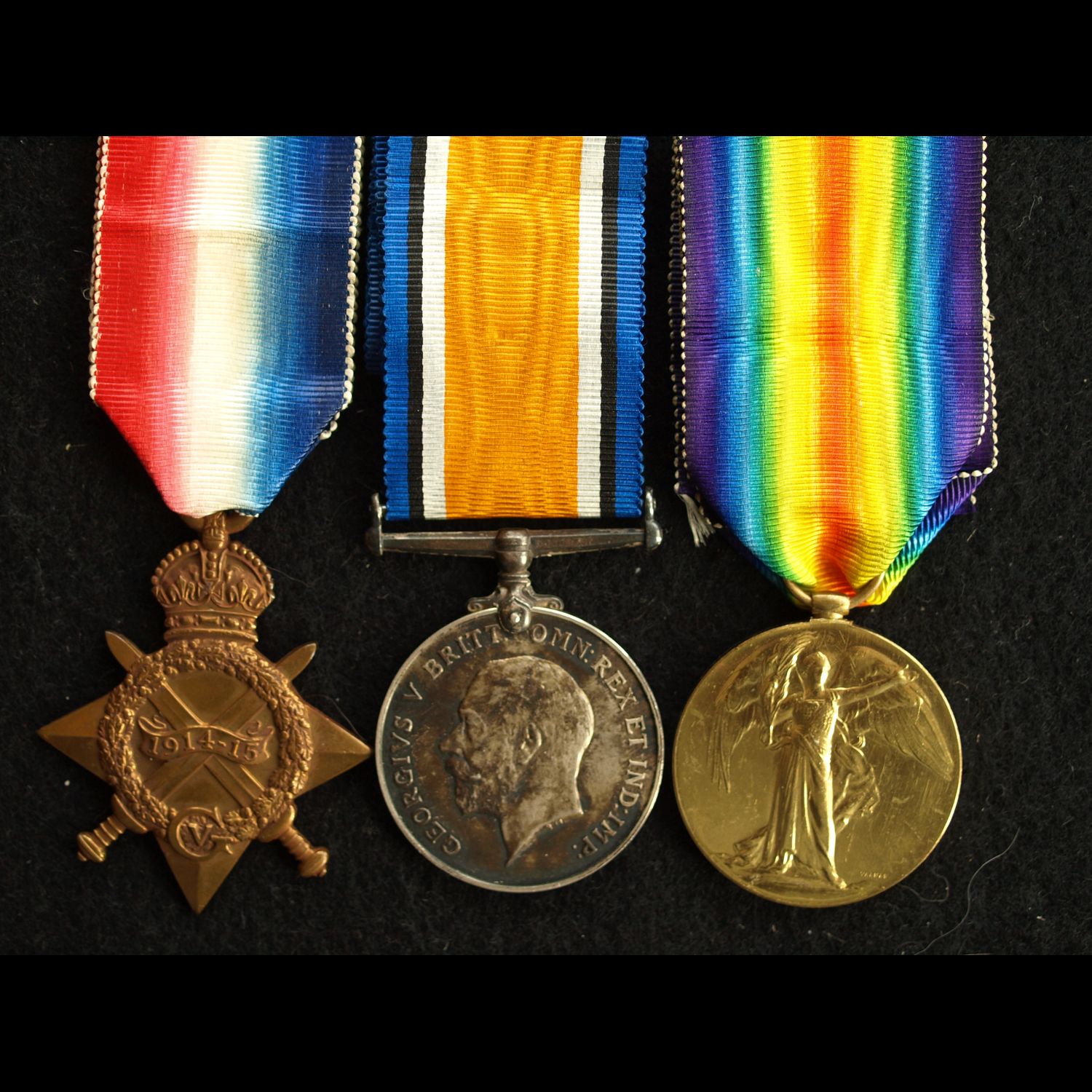
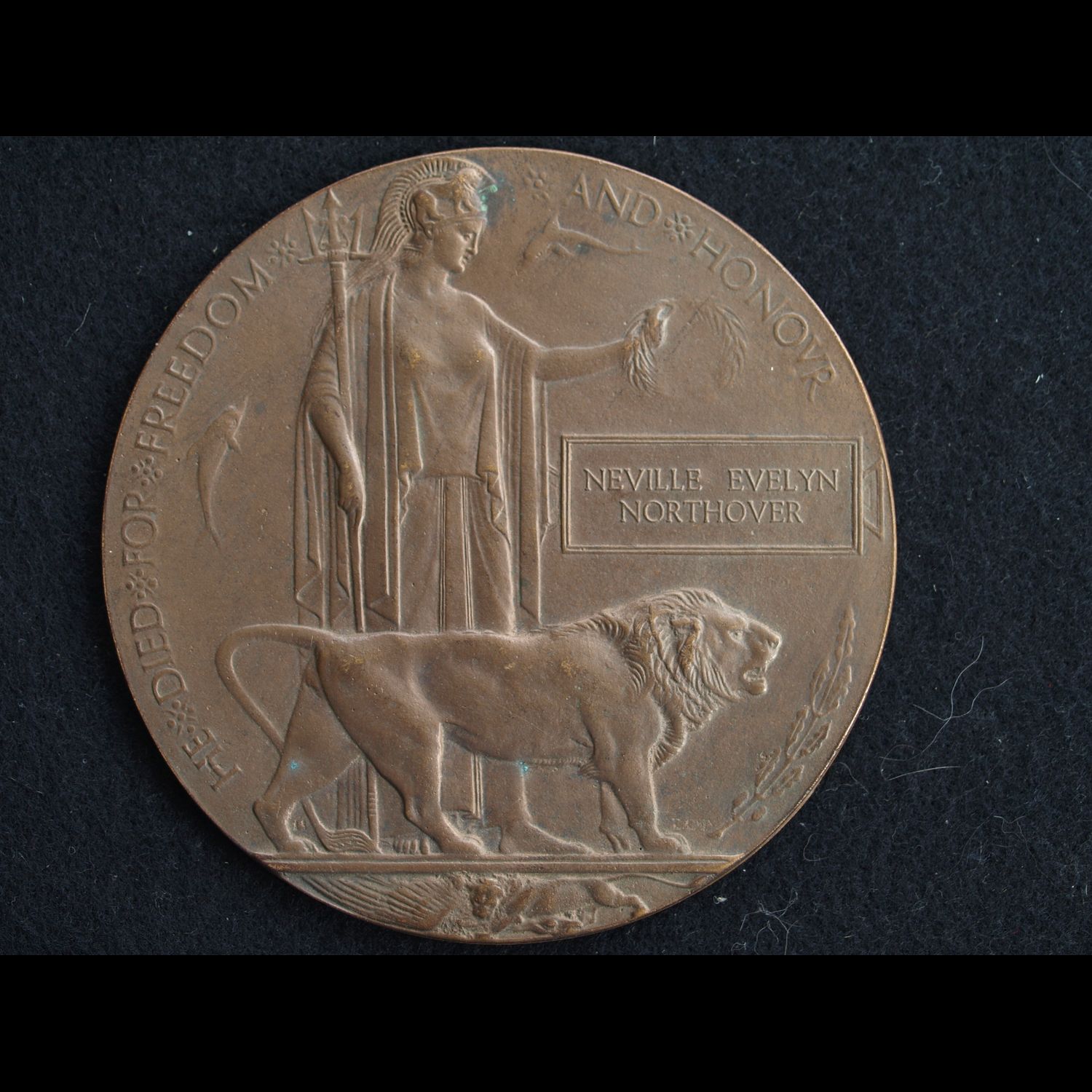
1914/15 Trio & Memorial Plaque Lt Northover KIA 15th Hampshire Regt served Lincs Yeo SS Mercian and Camel Corps
Author:
1 in stock
1914/15 Star named 1467 PTE N NORTHOVER LINC YEO, British War & Victory Medals named 2 LIEUT N E NORTHOVER & Memorial Plaque named NEVILLE EVELYN NORTHOVER.
Neville Evelyn Northover born in Poole, Dorset in 1892, Son of Edward and Henrietta Northover of Southsea, Hampshire. In 1911 he was a farm pupil in Hough and played cricket for the village.
In 1914 he was living in Hornington and was serving as a Trooper with the Grantham troop of the Lincolnshire Yeomanry numbered 1467, he is noted as being on the 19132-1914 Annual Camps with them. On 21st Nov 1915 he was sent to Egypt with them and set sail on SS Mercian.
In 1915 the Mercian was requisitioned as a troopship and on 17th October 1915 she sailed from Southampton with 400 soldiers of the Lincolnshire Yeomanry on board, bound for Salonica. The ship encountered very rough weather in the Bay of Biscay and both men and horses suffered badly from seasickness. The Mercian briefly put into Gibraltar, but the troops were not permitted to go ashore as there were concerns about security. The Mercian set sail again on 3rd November and the weather conditions were very favourable; it was a sunny day and the sea was calm. The soldiers took the opportunity to relax in the sun, clean their equipment and do their washing. However, at around 2.15 in the afternoon a shell suddenly whistled over the Mercian’s decks, the round having been fired by the German submarine U38. As the U38 had used all her torpedoes, and the Mercian was unescorted and unarmed, the submarine’s captain, Max Valentiner, decided to carry out an attack using the U-boat’s deck gun. Valentiner was a highly proficient commander and he finished the war as Germany’s third most successful U-boat captain, having sunk 300,000 tons of Allied shipping. The captain of the Mercian, C T Walker, increased speed and began to zig-zag, but Valentiner’s well-drilled gun crew soon found the range and their third shell hit the troopship amidships. The exploding shell caused terrible damage on board the crowded troopship: “It is just not possible to describe the scenes of carnage,” said one trooper. “Bits and pieces of men, horses and ship were everywhere. All of this covered in steam and thick black smoke.” The ship’s purser later reported that “…many an act of heroism was done….the Chaplain, Capt Holmes, moved about with a courageous spirit of cheerfulness. He tended the wounded, consoled the dying. A shell tore through the bridge deck, carrying away the staircase, and fell without exploding and it was the Padre who picked it up and flung it overboard.” Unfortunately, the Mercian’s quartermaster disappeared when the attack began and Captain Walker was obliged to take the helm. He was subsequently relieved from steering the ship by Private Edwin Thompson. Through skilful handling the Mercian managed to avoid many of the U38’s shells, but the ship began to lose power when some steam pipes were ruptured. Captain Walker called for volunteers and a number of men from the Yeomanry who were peacetime Grimsby trawlermen managed to make temporary repairs with some sacking. Meanwhile on the upper decks, Major J W Wintringham ordered the Yeomanry’s machine guns to be brought up in a desperate attempt to return the submarine’s fire. It proved to be a futile gesture, as the U38 was out of range, but the Mercian was about be given a reprieve, for after an hour of shelling Valentiner decided to break off the attack. Many of those who were killed on board the Mercian were buried at sea the following morning. The badly damaged ship managed to reach the North African port of Oran, where the wounded were landed. Several of those who were badly injured subsequently died, including Captain Thomas Trollope, Baron Kesteven, who was only 24 years old. The Yeomanry’s total casualties on the Mercian were 23 dead and 55 wounded. Once the worst of the damage to the Mercian’s hull had been repaired, the ship proceeded to Malta. Further repairs were undertaken in the dockyard at Valletta and, to ensure that the events of 3rd November were not repeated, a 12 pounder naval gun was fitted on the Mercian’s stern. The Mercian then sailed for Alexandria, rather than Salonica, as intelligence had been received that the Turkish Army was planning to attack the Suez Canal.
He served in Palestine with the Imperial Camel Corps and then in Dec 1916 he was sent back to the UK to be commissioned into the Royal Field Artillery. Unfortunately it was considered he was not up to the technical side and he was transferred to an infantry regiment, Wiltshire Regiment as a 2nd Lt. He stayed in the UK from 3rd Jan 1917 to 25th Mar 1918 when he was attached to the 15th (Hampshire Yeomanry) Hampshire Regiment and sent to France.
On 4th Sept 1918 he was in the Ypres sector when the regiment where detailed to attack the German trenches near Kemmel. It was a hastily organised attack and by 4am they were assembled behind the Chinese Trench with the first objective being railways west of Bois Quarante. The british artillery fell mainly behind the enemy positions so the men were met with a hail of machine gun and sniper fire, causing heavy casualties. A few reached the railway line and were told to hold it but the Germans counterattacked at 7am and they were forced to withdraw.
The regiment that day lost 8 officers and 90 men killed and missing, with a further 6 officers and 220 men wounded, some of whom had been gassed during the attack and counterattack.
Sadly this was the end for Neville and he was killed in action on this day and is buried at Voormezeele, Ypres aged 27 years old.